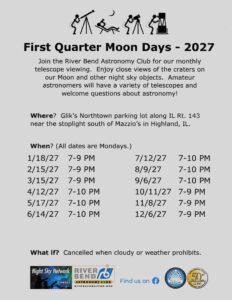
The Glik’s Company is kind enough once again to let us set up telescopes on the front of their shopping center along Rt. 143 in Highland, IL. Print off the attached date list for easy reference. We hope to see you on at least one of those nights.

Oct 26
The Glik’s Company is kind enough once again to let us set up telescopes on the front of their shopping center along Rt. 143 in Highland, IL. Print off the attached date list for easy reference. We hope to see you on at least one of those nights.
Sep 28
What’s Up in the Night Sky – October 2026
from In-The-Sky.org
Moon Phases
Last Quarter – October 3
New Moon – October 10
First Quarter – October 18
Full – October 25 – The Hunter’s Moon
Close Encounters
October 2: M31 (Andromeda Galaxy) is at opposition tonight.
October 4: Saturn is at opposition tonight.
October 4: Asteroid 2 Pallas is at opposition tonight. It shines at magnitude 8.2 in Cetus.
October 5: The waning crescent Moon passes 1 degree north of Mars in the early morning sky. Mars shines at magnitude 1.1 and the Moon at -11.5, both in Cancer.
October 5: Close approach of the Moon and the Beehive Cluster (M44) in the predawn sky.
October 6 (predawn): At 3:18am the Moon occults Jupiter low in the eastern sky. Jupiter reappears at 4:17am. DON’T MISS!
October 8: Mercury is at its highest altitude in the evening sky, albeit only 8 degrees above the horizon at sunset.
October 11 (predawn): Mars and the Beehive Cluster (M44) pass within 5 arcminutes of each other. Mars will be magnitude 1.1 and the Beehive at magnitude 3.1. This might be a nice subject for astrophotographers!
October 13: Asteroid 4 Vesta is at opposition tonight, shining at magnitude 6.5 in Cetus.
October 21: The Orionid meteor shower peaks tonight. The Moon is only 3 days away from full and may interfere with viewing. Expect a maximum Zenithal Hourly Rate around 15 before accounting for lunar light interference. See Meteor Shower section below for more information.
October 23: Venus reaches inferior solar conjunction, ending the current evening apparition and beginning the next morning apparition.
October 24: The Moon and Saturn are in conjunction, with the Moon passing almost 7 degrees north of Saturn.
October 26: The Perseus Double Cluster (NGC 869 and NGC 884) are at opposition tonight.
October 27: The Moon and the Pleaides (M45) pass within a degree of each other. The Moon will be 2 days past full and will wash out the fainter members.
Major Meteor Showers – from https://www.amsmeteors.org/meteor-showers/meteor-shower-calendar/
The Orionid Meteor Shower is active from October 2 through November 7, peaking on the night of October 21-22. Under ideal skies expect to see between 10 and 20 shower members. The waxing gibbous Moon will create significant interference but the brightest members should still be visible.
Planet Watch for October 15, 2026
Mercury is not observable as it is no higher than 3° above the western horizon at dusk.
Venus has ended its current evening apparition. Venus is not yet visible as a morning object as it is only 4° above the horizon at sunrise.
Mars rises around 1am local time, keeping company with the Beehive Cluster in Cancer. Mars shines at magnitude 1.0 and is visible until dawn around 6:30am.
Jupiter rises above the eastern horizon around 2am. Jupiter brightens to magnitude -2.08 in Cancer and reaches an altitude of 52° above the southeastern horizon until washed out by the sunrise.
Saturn reached opposition on October 4 and is visible nearly all night. It becomes visible 10° above the eastern horizon around 7:00pm. Saturn shines at magnitude 0.3 in Cetus; its rings opening up for a better view.
Uranus becomes accessible in the east around 8:20pm and reaches an altitude of about 72° above the southern horizon at 3:35am. Uranus shines at magnitude 5.6 in Taurus. The ice giant reaches opposition next month.
Neptune becomes accessible around 7:30pm and reaches maximum altitude of 50° above the southern horizon at 11:30pm. Neptune shines faintly at magnitude 7.8 in Pisces. Neptune reached opposition last month.
Sep 03
Come see us when we are out and about in September and October, 2026. Public events are for everyone!
Dobson Fest, Broemmelsiek Park, Defiance, MO, Saturday, September 19, 3 – 11 pm
First Quarter Moon Night, Northtown Shopping Center, Highland, IL, September 21, 7-10 PM
Balloons Over Marine Festival, Marine, IL, Friday/Saturday, September 25-26, Friday 4-11pm, Saturday 11am-11pm.
After Dark in the Park, Lakeview Park, Waterloo, IL, Saturday, October 10, 6 to 8:30 pm.
Schon Park, Glen Carbon, IL, Saturday, October 17, 6-9 PM
First Quarter Moon Night, Northtown Shopping Center, Highland, IL October 19, 7-9 PM