What’s Up in the Night Sky – August 2025

What’s Up in the Night Sky – August 2025

from In-The-Sky.org


Moon Phases


First Quarter – August 1


Full – August 8 – Full Sturgeon Moon


Last Quarter – August 16


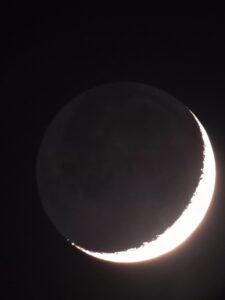
New Moon – August 23


First Quarter – August 31


Close Encounters


July 28: The Piscis Austrinid meteor shower reaches peak activity in the early morning.

*The 4-day-old Moon visits Mars low in the evening western sky.


July 30: Both the Southern delta-Aquariid and alpha-Capricornid meteor showers reach their peak in the early morning hours.


July 30-31: The Moon and Spica have a close encounter around Midnight local time. The Moon occults Spica for portions of Antarctica.


August 1: Venus reaches its highest altitude at 32° above the horizon at sunrise.


August 3: The Moon and Antares have a close encounter in the evening sky. The Moon occults Antares for parts of the southern hemisphere.


August 6: Saturn and Neptune are in conjunction 1° apart in the early morning before sunrise.


August 9: Asteroid 2 Pallas is at opposition in Delphinus, glowing at a dim magnitude of 9.4.


August 12: In the early morning, Venus and Jupiter are in conjunction less than a degree apart. Venus will be at magnitude -4.0 and Jupiter at magnitude -1.9.

*The Perseid meteor shower reaches its peak in the early morning hours.

*The Moon and Saturn are in conjunction, 4° apart in the evening.


August 19: Mercury will be at its greatest separation from the Sun (16 degrees at sunrise) in the early morning and shining at magnitude -0.2.

*The Moon and Jupiter are in conjunction in the morning sky.


August 20: The Moon and Venus are near conjunction in the morning sky.


August 21: The Moon and Mercury are near conjunction in the morning sky.


Major Meteor Showers – from https://www.amsmeteors.org/meteor-showers/meteor-shower-calendar/


The Southern Delta Aquariids is best seen from the southern tropics this shower is active from July 18 through August 12 and peaks for a week near the middle of this time (end of July). Not known for persistent trains of fireballs, the median rate of 25/hour consists mainly of faint meteors.  Parent body is believed to be comet 96P/Machholz.


The Alpha Capricornids are active from July 12 through August 12 with a peak centered around July 30. Known for producing bright fireballs but the rate is only 5 per hour. Parent body is Comet 169P/NEAT.


The Perseids are active from July 17 to August 23 with a peak near August 12 and are one of the best-known meteor showers. Hourly rate at the peak is near 100 per hour but a bright Moon in the sky this year will reduce the number of visible meteors to maybe 25%. Parent body Comet 109P/Swift-Tuttle.


Planet Watch for July 26, 2025


Mercury soon passes between the Earth and the Sun and no longer be visible in the evening sky for this apparition.  It will be visible in the morning sky in mid-August.


Venus rises at 3am and is magnitude -4 for most of the month.


Mars is in Leo and ending its most recent apparition.  Mars sets at 10:40pm tonight and by 9:10pm by the end of August. Mars reaches superior conjunction (when Mars is on the opposite side of the Sun from Earth) on January 9, 2026.


Jupiter rises in the morning sky around 4am (about 2 hours before the Sun) in late July and around 2:30am by the end of August.


Saturn rises in the east around 10:45pm at the end of July and around 9:45pm by the end of August.  Opposition for Saturn is September 21. The southern faces of the rings are coming into view, even if only at about a 4° tilt from our vantage point.


Uranus rises around 1:20am late July and before Midnight by late August. It is currently in the constellation Taurus.


Neptune rises about 11:10pm in late July and around 8:45pm by late August. It is currently in the constellation Pisces.

What’s Up in the Night Sky – July 2025

What's Up In The Night Sky

What’s Up in the Night Sky – July 2025

from In-The-Sky.org

Moon Phases

New Moon – June 25

First Quarter – July 2

Full – July 10 – Full Buck Moon

Last Quarter – July 17

New Moon – July 24

First Quarter – August 1

Close Encounters

June 29: Moon and Mars have a near miss. A 5-day old Moon passes just below Mars in the western sky.

July 3: Another near miss.  The 8-day old Moon passes below Spica in the southern sky.

July 3: Mercury reaches its greatest elongation from the Sun (largest separation from the Sun) but will still be less than 16° above the setting Sun in the western sky.

July 16: An early morning close approach of the nearly last-quarter Moon, Saturn, and Neptune.

July 21: An old crescent Moon and Venus have a wide conjunction in the predawn sky, rising together around 3am.

July 22: Two days from new, the thin crescent Moon rises with Jupiter around 4:15am.

July 25: Pluto is at opposition to Earth in Capricornus.  At magnitude 15.0 it will be indistinguishable from nearby background stars.

Major Meteor Showers – from https://www.amsmeteors.org/meteor-showers/meteor-shower-calendar/

The Southern Delta Aquariids is best seen from the southern tropics this shower is active from July 18 through August 12 and peaks for a week near the middle of this time (end of July). Not known for persistent trains of fireballs, the median rate of 25/hour consists mainly of faint meteors.  Parent body is believed to be comet 96P/Machholz.

The Alpha Capricornids are active from July 12 through August 12 with a peak centered around July 30. Known for producing bright fireballs but the rate is only 5 per hour. Parent body is Comet 169P/NEAT.

The Perseids are active from July 17 to August 23 with a peak near August 12 and are one of the best-known meteor showers. Hourly rate at the peak is near 100 per hour but a bright Moon in the sky this year will reduce the number of visible meteors to maybe 25%. Parent body Comet 109P/Swift-Tuttle.

Planet Watch for June 28, 2025

Mercury is a faint evening object on this date, setting shortly after 10pm. By late July it is moving to pass between the Earth and the Sun and no longer be visible in the evening sky for this apparition.

Venus rises at 3am and is magnitude -4 for most of the month.

Mars is in Leo and ending its most recent apparition.  Mars sets at Midnight tonight and by 10:30pm by the end of July.

Jupiter just passed through solar conjunction on June 24 and is not visible. By the end of July Jupiter rises in the morning sky about 2 hours before the Sun.

Saturn rises in the east around 12:45am at the end of June and around 10:45pm at the end of July.  Opposition for Saturn is September 21. The southern faces of the rings are coming into view, even if only at about a 4° tilt from our vantage point.

Uranus reached solar conjunction on May 17 and is not visible, being only 5° above the horizon at dawn in late June and 38° above the horizon in late July.

Neptune is a very faint object in the east at magnitude 7.8, rising around 12:30am in late June and rising about 10:40pm in late July.


The New Current Astronomy is Out!!

Current Astronomy Winter-Spring 2025