How Big Is Pluto? New Horizons Settles Decades-Long Debate | NASA

Charon and Pluto

A portrait from the final approach. Pluto and Charon display striking color and brightness contrast in this composite image from July 11, showing high-resolution black-and-white LORRI images colorized with Ralph data collected from the last rotation of Pluto. Color data being returned by the spacecraft now will update these images, bringing color contrast into sharper focus.
Credits: NASA-JHUAPL-SWRI

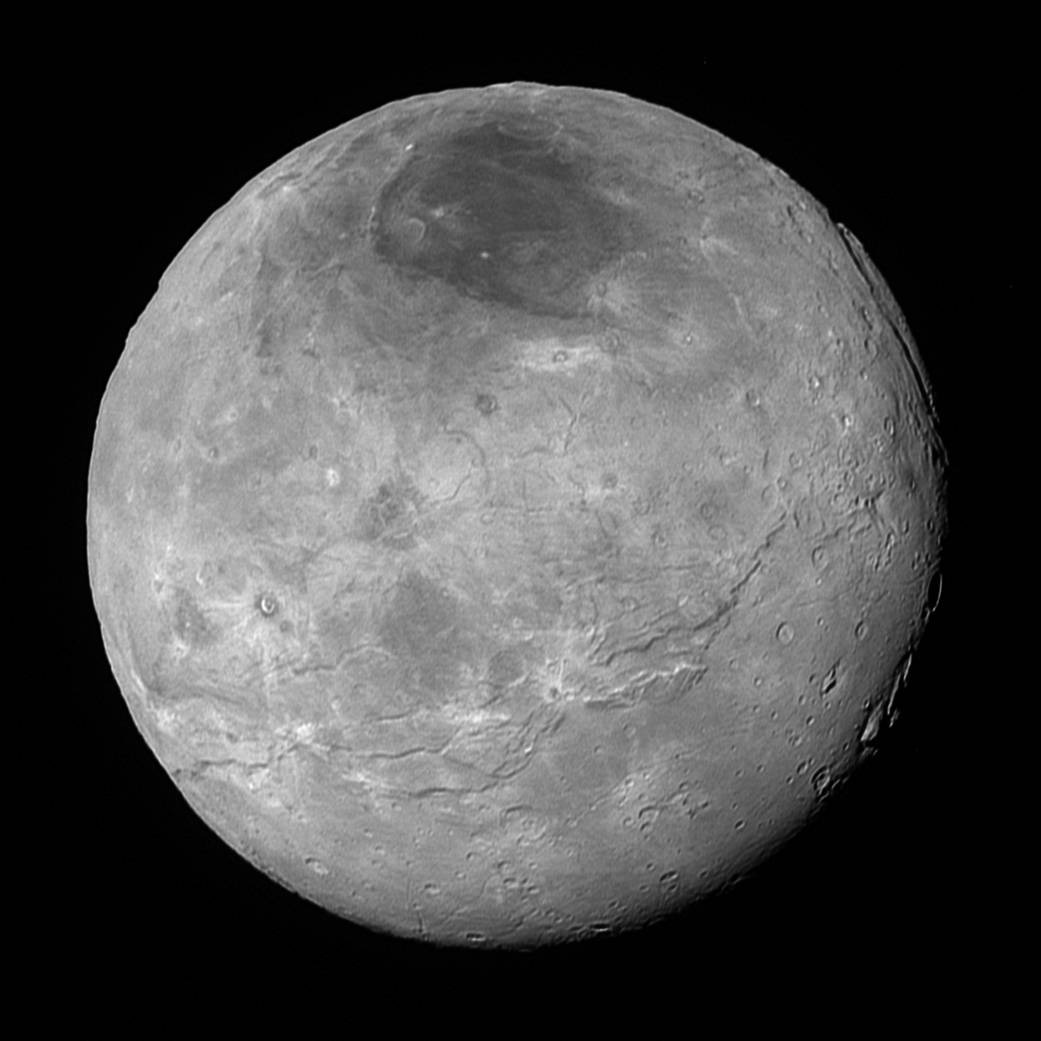
NASA’s New Horizons mission has answered one of the most basic questions about Pluto—its size. Mission scientists have found Pluto to be 1,473 miles (2,370 kilometers) in diameter, somewhat larger than many prior estimates. Images acquired with the Long Range Reconnaissance Imager (LORRI) were used to make this determination. This result confirms what was already suspected: Pluto is larger than all other known solar system objects beyond the orbit of Neptune. “The size of Pluto has been debated since its discovery in 1930. We are excited to finally lay this question to rest,” said mission scientist Bill McKinnon, Washington University, St. Louis. Pluto’s newly estimated size means that its density is slightly lower than previously thought, and the fraction of ice in its interior is slightly higher. Also, the lowest layer of Pluto’s atmosphere, called the troposphere, is shallower than previously believed. Measuring Pluto’s size has been a decades-long challenge due to complicating factors from its atmosphere. Its largest moon Charon lacks a substantial atmosphere, and its diameter was easier to determine using ground-based telescopes. New Horizons observations of Charon confirm previous estimates of 751 miles (1208 km) kilometers) across LORRI has also zoomed in on two of Pluto’s smaller moons, Nix and Hydra. “We knew from the time we designed our flyby that we would only be able to study the small moons in detail for just a few days before closest approach,” said New Horizons Principal Investigator Alan Stern of the Southwest Research Institute, Boulder, Colorado. “Now, deep inside Pluto’s sphere of influence, that time has come.” Nix and Hydra were discovered using the Hubble Space Telescope in 2005. Even to Hubble, they appeared as points of light, and that’s how they looked to New Horizons until the final week of its approach to Pluto. Now, the latest LORRI images show the two diminutive satellites not as pinpoints, but as moons seen well enough to measure their sizes. Nix is estimated to be about 20 miles (about 35 kilometers) across, while Hydra is roughly 30 miles (roughly 45 kilometers) across. These sizes lead mission scientists to conclude that their surfaces are quite bright, possibly due to the presence of ice. What about Pluto’s two smallest moons, Kerberos and Styx? Smaller and fainter than Nix and Hydra, they are harder to measure. Mission scientists should be able to determine their sizes with observations New Horizons will make during the flyby and will transmit to Earth at a later date.

Read Full Story Here

New Image of Pluto: “Houston, We Have Geology” | NASA

Pluto

It began as a point of light. Then, it evolved into a fuzzy orb. Now – in its latest portrait from NASA’s New Horizons spacecraft – Pluto is being revealed as an intriguing new world with distinct surface features, including an immense dark band known as the “whale.” As the newest black and white image from New Horizons’ Long Range Reconnaissance Imager (LORRI) appeared on the morning of July 10, members of the science team reacted with joy and delight, seeing Pluto as never before. There will no doubt be many similar moments to come. New images and data are being gathered each day as New Horizons speeds closer to a July 14 flyby of Pluto, following a journey of three billion miles. “We’re close enough now that we’re just starting to see Pluto’s geology,” said New Horizons program scientist Curt Niebur, NASA Headquarters in Washington, who’s keenly interested in the gray area just above the whale’s “tail” feature. “It’s a unique transition region with a lot of dynamic processes interacting, which makes it of particular scientific interest.”  New Horizons’ latest image of Pluto was taken on July 9, 2015 from 3.3 million miles (5.4 million kilometers) away, with a resolution of 17 miles (27 kilometers) per pixel. At this range, Pluto is beginning to reveal the first signs of discrete geologic features. This image views the side of Pluto that always faces its largest moon, Charon, and includes the so-called “tail” of the dark whale-shaped feature along its equator. (The immense, bright feature shaped like a heart had rotated from view when this image was captured.)  “Among the structures tentatively identified in this new image are what appear to be polygonal features; a complex band of terrain stretching east-northeast across the planet, approximately 1,000 miles long; and a complex region where bright terrains meet the dark terrains of the whale,” said New Horizons principal investigator Alan Stern. “After nine and a half years in flight, Pluto is well worth the wait.”

Read Full Story Here

Pluto and Charon, Now in Color


The first color movies from NASA’s New Horizons mission show Pluto and its largest moon, Charon, and the complex orbital dance of the two bodies, known as a double planet. “It’s exciting to see Pluto and Charon in motion and in color,” says New Horizons Principal Investigator Alan Stern of the Southwest Research Institute (SwRI), Boulder, Colorado. “Even at this low resolution, we can see that Pluto and Charon have different colors—Pluto is beige-orange, while Charon is grey. Exactly why they are so different is the subject of debate.” New Horizons will make its closest approach to Pluto on July 14, zipping by about 7,800 miles (12,500 kilometers) above the surface. It’s the first mission to Pluto and the Kuiper Belt, a relic of solar system formation beyond Neptune. Sending a spacecraft on this almost 3-billion mile journey will help us answer basic questions about the surface properties, atmospheres and moons of the Pluto system. These near-true color movies were assembled from images made in three colors – blue, red and near-infrared – by the Multicolor Visible Imaging Camera on the instrument known as Ralph, a “Honeymooners” reference that classic TV fans can appreciate. The images were taken on nine different occasions from May 29-June 3. Although the two movies were prepared from the same images, they display the Pluto-Charon pair from different perspectives. One movie is “Pluto-centric,” meaning that Charon is shown as it moves in relation to Pluto, which is digitally centered in the movie. (The North Pole of Pluto is at the top.) Pluto makes one turn around its axis every 6 days, 9 hours and 17.6 minutes—the same amount of time that Charon rotates in its orbit. Looking closely at the images in this movie, one can detect a regular shift in Pluto’s brightness—due to the brighter and darker terrains on its differing faces. The second movie is barycentric, meaning that both Pluto and Charon are shown in motion around the binary’s barycenter – the shared center of gravity between the two bodies as they do a planetary jig. Because Pluto is much more massive than Charon, the barycenter (marked by a small “x” in the movie) is much closer to Pluto than to Charon.

Read Full Story Here